
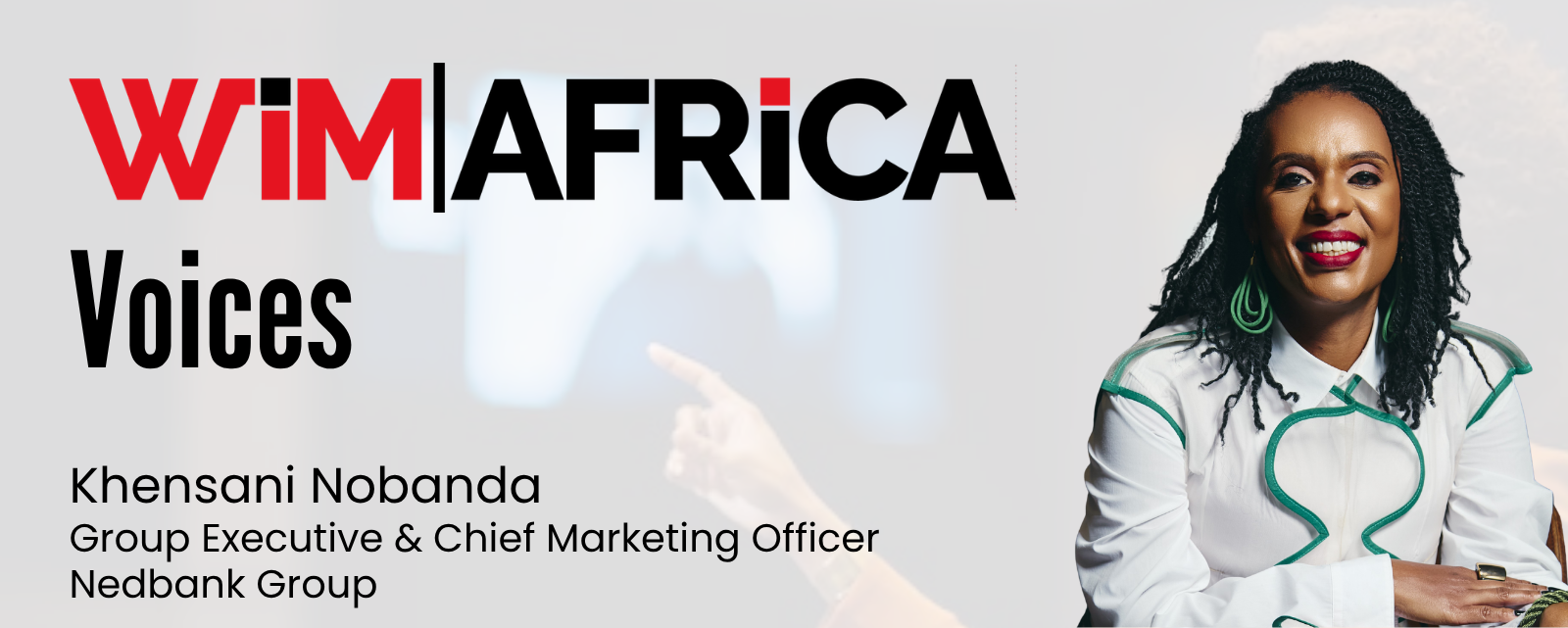
Each month, we spotlight one piece of thinking from a senior leader in the WiM Africa community — an article, report, talk or point of view that genuinely adds to industry conversations.
By Khensani Nobanda - Group Executive & Chief Marketing Officer, Nedbank Group
One of the assumptions I challenge most often is the idea that creativity and responsibility sit at opposite ends of a spectrum. In banking, people sometimes believe you have to choose. You can be bold or you can be trusted. You can move quickly or you can manage risk. You can be creatively ambitious or commercially disciplined. I don't believe that. In fact, I think the strongest brands are built precisely because they find a way to do both.
Over the years, I've come to realise that creativity is not about being loud. It's not about chasing trends or producing work that wins applause in boardrooms and award shows. The best creativity solves a problem, creates relevance, and earns trust. That lesson becomes even more important when you're building brands across Africa.
At Nedbank, we operate across South Africa, Namibia, Eswatini, Lesotho, Mozambique and Zimbabwe. One of the mistakes organisations often make is thinking about their "home market" and then treating the rest of Africa as one homogeneous audience. Africa is far too diverse for that. The challenge isn't to create entirely different brands for every market. It's to understand which human truths are universal and which cultural nuances require a different expression. The need for security, financial confidence, belonging and opportunity is remarkably consistent across markets. The way those needs show up can be very different.
That's why I've always believed that brands should start with people before products. Some of Nedbank's most impactful work has emerged from that principle. Money Secrets resonated because it recognised something many marketers miss: money is never just about money. It is emotional. It is tied to aspirations, family expectations, identity, anxiety, status and hope. The campaign succeeded because it started a conversation people were already having, often privately, and helped bring it into the open.
The same was true of our retirement savings campaign featuring older South Africans who were still working because they could not afford to retire. Retirement planning can easily become a technical financial message. Instead, we chose to tell a deeply human story. What moved people wasn't the financial product. It was the reality reflected back to them.
Those experiences reinforced something I've learned throughout my career: relevance is the highest form of creativity. Consumers don't reward novelty for its own sake. They reward brands that make their lives easier, help them navigate complexity, or make them feel understood. That's where responsible risk-taking begins. There is a perception that taking risks means pushing boundaries for the sake of attention. I see it differently. Responsible risk-taking is having the courage to speak honestly about issues people care about, while remaining disciplined enough to protect the trust they place in your brand.
In a banking environment, trust isn't a nice-to-have. It is the foundation of everything. That means we need to be brave without being reckless. Bold without becoming confusing. Innovative without compromising confidence.
I've also become increasingly convinced that data and creativity are not opposing forces. The most effective marketing organisations bring them together. Data helps us understand behaviour. It tells us where friction exists, how customers engage, and what choices they make. Creativity helps us understand the human story behind those decisions. The most powerful work happens when you combine both. Data might tell us that a customer isn't saving enough for retirement. Creativity helps us understand the hopes, fears and competing priorities influencing that behaviour. One provides information. The other creates meaning.
This balance becomes even more critical as artificial intelligence reshapes the marketing landscape. AI is already helping organisations move faster, generate content and uncover insights at scale. But I've never believed that technology removes the need for human judgement. If anything, it increases it. Across a continent as diverse as Africa, scale should never come at the expense of nuance. Technology can help us personalise experiences and identify opportunities, but it cannot replace cultural understanding, empathy or sound judgement. These remain distinctly human capabilities.
The brands that will thrive in the future are not necessarily those using the most AI. They will be the brands that use AI thoughtfully, responsibly and in service of genuine human relevance. For me, that is what creative excellence looks like. It is not creativity for creativity's sake. It is the discipline to understand people deeply, the courage to challenge conventions when necessary, and the wisdom to know which boundaries should never be crossed.
The campaigns that have had the greatest impact in my career all share one thing in common. Whether they focused on financial planning, money conversations or celebrating young South Africans, they were rooted in universal human emotions: hope, ambition, responsibility, uncertainty and aspiration. Those emotions travel.
That is why I remain optimistic about the future of African brands. We have an opportunity to build organisations that are globally competitive while remaining deeply connected to the realities of the communities we serve. When we start with human truth, respect local context and have the courage to evolve alongside our customers, creativity becomes far more than communication. It becomes a force for relevance, trust and sustainable growth.